


Research Note
Robotic Milking?
Maintain Optimal PMR
USDA’s Economic Research Service recently reported on the steady — but not dramatic — rise in robotic milking. The increase included farms in the Tri-State area, mainly in operations milking fewer than 500 cows.
Powering the growth in robotic milking: Producer efforts to lower production costs, particularly for skilled labor, while maintaining cow performance. Today, ongoing concerns for labor availability and growing interest in precision dairy farming may accelerate the trend.
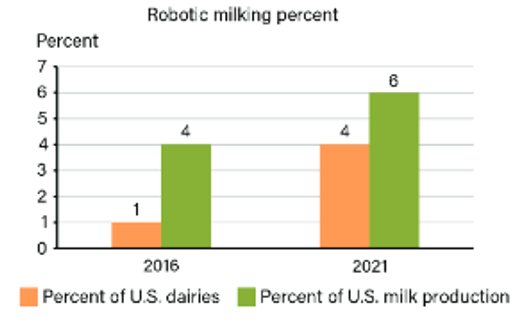
Adapted from “Precision Dairy Farming, Robotic Milking, and Profitability in the United States”, J. McFadden & Z. Raff, 2026
What lies ahead and how does it affect the bulk of a dairy diet?
Robotic milking, patented in the Netherlands in the early 1990s and later introduced into North America, builds on decades of development and experience. Nonetheless, from farm to farm, there remains a wide diversity of robotic milking applications and associated feeding strategies.
 Also, notes Utah State’s Dr. Katie Kennedy automated feeding and milking systems continue to evolve at a rapid pace.
Farm-to-farm diversity and the evolution of the technology continue to complicate research to optimize what Canadian researchers have termed “a fundamental shift in nutritional management“. This change divides the ration into a partial mixed ration (PMR) fed at the bunk and the automated milking system (AMS) feed product, typically a manufactured concentrate, fed in the milk box.
Acknowledging the variety of barn designs, planned traffic patterns, stages of lactation, and individual cow behaviors, Kennedy considers for example robotic milking in a “free-flow traffic” system. In such a system, the cow voluntarily initiates feeding in the milk box.
“As a starting point,” Kennedy suggests, “keep in mind that the PMR, which may consist primarily of forage, typically constitutes around 80% of total dry matter intake (DMI). In addition to its nutrient content, the concentrate fed in the milk box functions as ‘bait’ for milking. So, we formulate the concentrate to compliment the PMR.”
Questions linking the AMS concentrate and its PMR:
- Is the level of concentrate consumption going to affect PMR consumption, either increasing or reducing total DMI?
- Is it going to impact levels of neutral detergent fiber (NDF) or rumen degradable starch available from the PMR?
- Can increasing or decreasing the AMS concentrate allocation — without changing the composition of the PMR — be used to change energy density of the diet for an individual cow?
- How is PMR management, including frequency of feed delivery and push-up, going to influence AMS usage and cow performance?
- To what extent is the PMR amenable to adjustments to energy balance in the diet through the concentrate, for example adding a molasses-based liquid feed supplement to minimize body condition loss in early lactation?
Dr. Kennedy is scheduled to speak at the 2026 Tri-State Dairy Nutrition Conference, which is sponsored in part by CBL and FeedInsight 4Dairy Supporting Sponsors.
For more on automatic feeding systems, see the Research Note.
Questions?
Email FeedInsight 4Dairy