

Research Note
Gut Check:
More SBM in Nursery Diets?
Weaning challenges a pig’s intestinal health — even under optimal rearing conditions, including adequate suckling, creep feeding, age and body weight, etc. The sudden change in diet from sow’s milk to dry feed causes critical changes in mucosal microbiota, inflammation, and oxidative stress as well as villus damages in the small intestine.
Traditionally, antibiotic growth promoters (AGP) helped support the weaned pig’s intestinal health by suppressing opportunistic bacterial pathogens and by other means. Anticipating even less AGP usage in the future, plus ongoing pressure to reduce diet costs, and today’s wide range of potentially useful additives — what lies ahead?
 “Intestinal health is key to nutrient digestion and growth,” says North Carolina State’s Dr. Sung Woo Kim, “and the first few days after weaning are critical.”
Today, feedstuffs market conditions can favor increased use of soybean meal (SBM) in diets for young pigs, which can increase the risk of intestinal health problems. Signs of trouble occur “after the insult” with diarrhea, feed refusal, etc. Pigs can recover, although they will have lost some period of potential growth.
Starting a decade ago to test dietary interventions on intestinal health and growth of nursery pigs, Kim’s lab has since conducted more than 70 studies involving at least 4,000 pigs
From the pigs’ jejunal mucosa, the NC State researchers quantified pro-inflammatory cytokines (TNF-a, IL8, IL6), immunoglobulins (IgG and IgA), oxidative damage products (malondialdehydes and protein carbonyls), morphology (villus height and crypt depth), and crypt cell proliferation (percentage of Ki-67+ cells). Overall, high levels of TNF-a, IL8, and malondialdehyde in the jejunal mucosa reduced average daily gain (ADG).
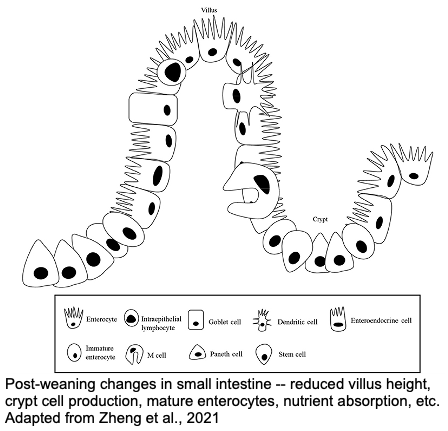 Meta-analysis confirmed that increased intestinal inflammation, oxidative damage, and humoral immune response in the jejunal mucosa were associated with reduced growth of nursery pigs.
Potential dietary interventions include organic acids, phytobiotics, probiotics, prebiotics, postbiotics, enzymes, functional amino acids, and other additives as summarized in a recent review. In addition, recent NC State work with enzymes in nursery pig diets may be applicable considering current and forecast low prices low prices for SBM.
For example, one study investigated “low cost feeds” (LCF) for nursery pigs where LCF consisted of more SBM, less animal protein, and no enzyme-treated SBM. Researchers found that LCF with β-mannanase:
- Decreased jejunal digesta viscosity
- Increased relative abundance of Lactobacillus while decreasing Helicobacter
- Restored levels of tight junction gene expression (ZO-1)
- Enhanced growth performance and improved feed conversion
Other LCF nursery diets may include “cocktails” of mannanase with other enzymes — for example, xylanase, glucanase, protease, phytase — because each enzyme targets a different substrate with possible synergistic effects on intestinal health and pig growth.
“However,” Kim cautions, “no matter the post-weaning dietary intervention strategy, understand the critical mechanisms of change that affect the intestinal microbiota and overall intestinal health. Healthy jejunal mucosa supports optimal growth in the nursery.”
Questions?
Email FeedInsight 4Swine